


AI readiness is not about adopting tools. It’s about redesigning how work flows through your organization. Most youth-serving organizations are still in early stages—informal experimentation, limited policies, curiosity without structure. That’s not a weakness. It’s a moment of opportunity.
The leaders who will benefit most from AI in the next two years are not moving fastest. They’re moving intentionally.
It is clear, the question is no longer “Should we use AI?”
It’s “How do we prepare thoughtfully?”
A Practical Framework for Youth Program Leaders
Preparing for the AI era begins with an honest inventory of your organization, including your systems, processes, people, and workflows. Where is work duplicative? Where is it dependent on individual effort instead of shared structure? Where are tools disconnected? AI readiness is both a cultural and tactical shift. It requires rethinking how work flows and how decisions are made, not just adding new technology.
When you’re willing to assess clearly and align leadership around change, you can begin applying a structured model to move forward with confidence.
The AI Readiness Flywheel
Standardize → Unify → Automate → Elevate Human Judgment
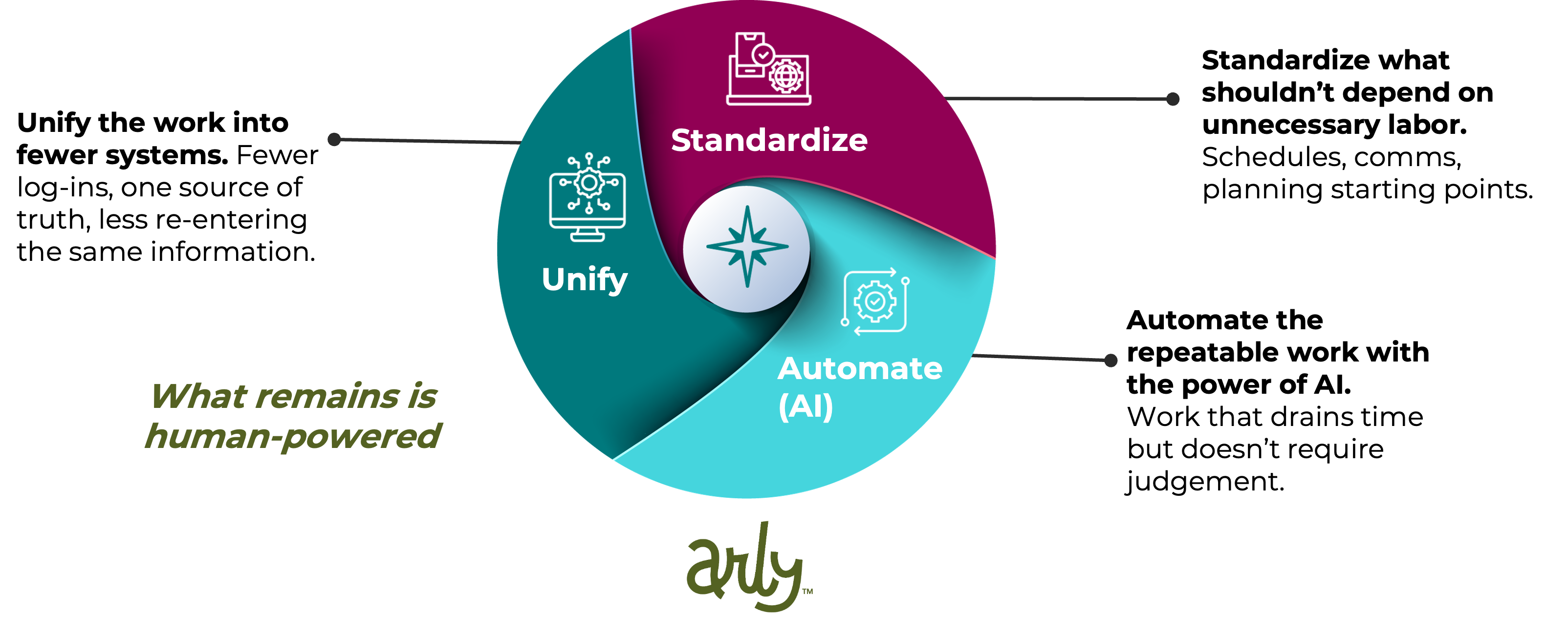
The Arly AI Readiness Flywheel shows how organizations protect mission and unlock possibility by standardizing processes, unifying systems, automating repeatable work, and elevating human leadership.
Preparing for the AI era starts with clarity. Our AI Readiness Flywheel is a practical visual to guide you; beginning with standardizing core workflows, identifying opportunities to unify work into fewer systems, and automating repeatable tasks with AI. As those gears turn together, you gain greater visibility, alignment, and confidence.
The six steps below outline how to apply this model in a thoughtful, structured way.
Step 1: Take an Honest Inventory
Before looking to apply AI, assess your organization clearly. Audit your systems, tools, and workflows. Where is work manual and disjointed? Where are teams re-entering the same information? Where are processes rebuilt each season instead of building forward?
Ask difficult questions:
- Do multiple tools do the same thing?
- Is there one true source of truth?
- How much time should this task truly take?
Many youth-serving organizations operate with a multitude of tools. Registration sits in one place. Attendance in another. Reporting somewhere else. And staff often compensate with manual workarounds.
Clarity creates leverage and AI amplifies structure. The clearer your starting point, the stronger the acceleration.
Step 2: Standardize What Should Be Predictable
Strong organizations often run on individual heroics. That’s admirable—but unsustainable.
Standardize what shouldn’t depend on unnecessary labor, such as:
- Program planning starting points
- Communication templates
- Reporting structures
- Scheduling frameworks
Consistency doesn’t eliminate creativity. It removes chaos. When planning builds forward instead of resetting every cycle, momentum can truly compounds.
Step 3: Unify Work into Fewer Systems
Systems should connect—or the burden shifts to people. And the goal is not to add more software. It’s to reduce friction.
Disconnected platforms create hidden labor: duplicate entry, manual follow-up, inconsistent reporting, and misalignment across teams.
During this step we want to unify where possible:
- Registration, attendance, and reporting
- Finance and operational visibility
- Communications and program delivery data
A centralized, connected system reduces operational drag and improves visibility across the organization.
Step 4: Automate the Repeatable Work
Once workflows are standardized and systems unified, automation becomes strategic. AI should handle work that drains time but does not require judgment:
- Drafting communications
- Generating structured plans
- Summarizing reports
- Analyzing trends
- Forecasting recurring patterns
See AI as an additional support person on your team. Automation frees leaders to focus on what truly requires human expertise—relationships, mentorship, strategic decision-making, and mission stewardship.
Step 5: Clarify What Humans Should Do
As automation increases, clarity becomes essential.
Take this time to evaluate roles and responsibilities. Determine which tasks truly require human judgment and which can be structured or automated. Prioritize what might be called “editor-in-chief thinking”—leaders who can set direction, shape strategy, and exercise discernment.
AI executes; humans interpret, elevate, and lead. This is not about reducing humanity in your work. It is about protecting it.
Step 6: Make AI a Shared Leadership Initiative
Technology alone does not transform organizations. Leadership does, and AI readiness should never be a one-person experiment.
When adoption sits with one individual, the potential for opportunity remains narrow. Instead, ask every senior leader to explore how AI could strengthen their area—program, operations, development, HR, finance, marketing.
Next convene a monthly or quarterly cross-functional session to share discoveries. Patterns across teams will. begin to emerge and your team will start to discover where a tool or workflow could serve the broader organization.
AI readiness requires:
- Willingness to question long-standing processes
- Courage to have difficult conversations
- Acceptance that some roles may evolve
- Commitment to training and transparency
- Alignment between tactical change and ideological shift
And remember, not everyone will be on board immediately. That’s normal. But leadership must drive the shift so that everyone else can see the direction clearly.
AI isn’t the point. Impact is.
What This Means for Your Organization
Preparing for AI does not mean chasing trends. It means strengthening your foundation so that when you do apply AI, it amplifies what already works.
To protect the mission, you must evolve. If you don’t, others will.
Organizations that standardize, unify, automate, and elevate human leadership will reduce operational burden, increase consistency across sites, and strengthen sustainability under pressure.
The work is not easy. But it is necessary. And it is possible.
Building on a Connected, AI-Enabled Foundation
For organizations looking to put this model into action, having the right infrastructure matters. A streamlined, AI-enabled platform like Arly supports this shift by connecting planning, operations, and reporting in one unified system. With embedded AI guidance, teams can standardize program workflows, reduce duplicate effort, automate repeatable tasks, and gain clearer visibility into performance—without adding complexity. The goal isn’t more technology. It’s better-connected support that allows humans to lead programs, not paperwork.
Who do I contact with questions?
👉 CLICK HERE to book a demo to see how Arly can help your team lead programs—not paperwork.