

Every program director knows turnover is expensive. Few have calculated what actually leaves when a staff member does.
It’s not just a body. It’s the kids’ names they remembered. The parent who needed a different approach. The way they ran Tuesday’s session without anyone having to ask. The judgment calls that never made it into a handbook because no one thought to write them down.
That knowledge doesn’t transfer when someone leaves. It evaporates. And the program that was running smoothly on a Monday is a different program by Thursday.
Staff turnover in youth programming is treated as a cost of doing business. It’s budgeted for, accepted, and managed. And the field has been raising the alarm for years. More than 8 in 10 afterschool program providers reported concerns about staffing in surveys conducted annually from 2021 through 2023, according to the Afterschool Alliance and National Afterschool Association. What’s rarely accounted for is the operational knowledge that walks out with every person who gives notice, and the invisible tax that every new hire places on the team left behind.
What is institutional knowledge in a youth program?
Institutional knowledge sounds like something that belongs in a corporate HR presentation. In youth programming, it’s far more concrete. And the stakes are measurably high: turnover rates in youth-serving organizations have been documented as high as 40% per year, according to research published in the journal Afterschool Matters. In a field built on relationships, that number has consequences that go well beyond budget lines.
It’s knowing which kids need extra time at check-in before they can settle. It’s understanding how to run the transition between activities without losing the room. It’s the scope and sequence your best staff member built from scratch last summer and carries around in her head. It’s how to document an incident clearly enough that it holds up under review. It’s the accumulated, practical intelligence that makes a program feel well-run rather than improvised.
The participant impact is direct. Research from one Boston-area middle school program found that a third of kids interviewed said they considered quitting the program when a staff member left. Turnover isn’t just an HR problem. It’s a program quality problem.
The knowledge that makes your program run well isn’t in a manual. It’s in your staff. That’s the risk.
The real cost of the learning curve
New staff don’t just need time. They need infrastructure that most programs haven’t built.
The first two weeks of a new hire aren’t onboarding — they’re survival. They’re your experienced staff answering the same questions twice a day while also running their own sessions. They’re quality dipping because there isn’t enough bandwidth to do both. They’re families noticing that something is different, even if they can’t name what it is.
The numbers bear this out. Research from Change Impact estimates that it costs approximately $2,000 every time a part-time OST staff member leaves, covering offboarding, recruitment, background checks, and onboarding alone. And that’s before factoring in lost productivity. According to SHRM, the full replacement cost of an employee ranges from 50% to 200% of their annual salary once productivity loss is included. For a field where part-time staff turn over at high rates, the cumulative cost across a program year is rarely captured — but it’s significant.
Most program operators absorb this as a fixed reality. It doesn’t have to be.
Most software has made this worse, not better
Program management platforms were built for administrators. The person with time to sit at a desk, navigate menus, run reports, and configure settings. They were not built for the staff member in a gymnasium with fourteen kids and a tablet, trying to take attendance between activities.
That mismatch has consequences. When software adds friction at the moments that matter most — check-in, incident documentation, activity transitions — it doesn’t solve the operational problem. It becomes part of it. Staff learn workarounds. They revert to paper. They skip the documentation step entirely. And the institutional knowledge that a platform was supposed to capture stays trapped in someone’s memory instead.
There is also a subtler version of this problem. When a platform requires significant training to use effectively, it ties institutional knowledge to the people who know how to use it. When those people leave, they take the platform knowledge with them too. The tool that was supposed to solve the problem of knowledge loss becomes another source of it.
What it looks like when intelligence is the default
The shift that matters isn’t more features. It’s where the intelligence lives.
In most programs, intelligence lives in people. Your most experienced staff carry the operational knowledge. Your longest-tenured director holds the institutional memory. When they leave, it goes with them. This is the design flaw. Not in the people — in the system.
The better model makes intelligence the default. It lives in the platform. A new staff member on day one has access to the same guidance, the same program structure, the same documented workflows as someone who has been there for three seasons. They don’t need to ask the right person the right question to learn how to do their job well. The platform tells them.
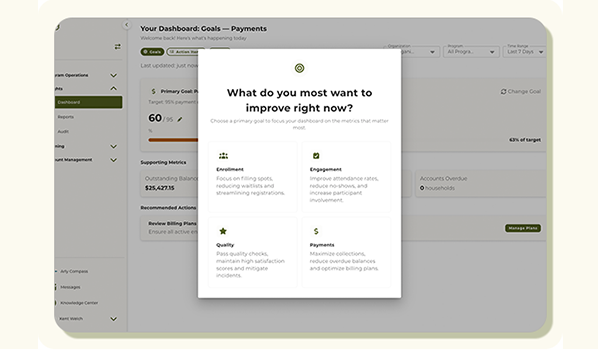
This is what Arly Compass is built to do. Not as an add-on, not as a chatbot bolted onto an existing product — but as an AI guide woven into the platform from the ground up. It knows your program. It knows your schedule, your participants, your content library. It helps your team set up faster, answer questions in real time, and build the scope and sequence that used to live only in one person’s head.
When the knowledge is in the platform, it doesn’t leave when the staff does.
When intelligence is the default, a new staff member on day one is not starting from zero. They’re starting from everything your program has already built.
Structured delivery as a retention tool
There is a version of this conversation that stops at operational efficiency. That misses the larger point.
Staff leave programs that feel chaotic. And most programs have no formal plan to address it: 80% of nonprofit leaders report having no talent retention strategy in place. The operational chaos that makes a job feel unsustainable is itself a retention problem — and it’s one most organizations haven’t connected to their platform choices.
When a platform provides genuine structure — clear activity plans, guided workflows, documented expectations, real-time guidance — the job of being a youth program staff member gets easier. Not in a way that removes the human element, but in a way that removes the friction that has nothing to do with the work itself. Staff can manage experiences rather than manage software.
Programs that feel well-run attract people who want to stay. The connection between platform quality and staff retention is underestimated in this industry. It is direct.
The questions to ask your platform
Not “does it have all the features?”
The right questions are:
-
Does it make my newest staff member effective on day one?
-
Does it carry the institutional knowledge so they don’t have to find it?
-
Does it guide them through your program’s structure so they’re not inventing it?
-
Does it document what happens so the next person has something to build on?
If the answers are no, the operational risk isn’t theoretical, it’s already in your building, and it leaves every afternoon at 6pm.
The programs that close that gap — that stop betting their operational continuity on individual people — are the ones that scale, that retain good staff, and that deliver consistent quality regardless of who walked in the door that morning.
That’s what it looks like when intelligence is the default.
Your platform should answer yes to all four questions above. If it doesn't, it's time to see one that does. Request a demo of Arly today.
SEE THE NEW ARLY
Request a Demo



%20(40).png)