


There's a gap between what youth-serving programs need and what most software actually delivers. And it costs programs more than they realize.
Program directors know the gap intimately. It shows up as the spreadsheet that still lives next to the platform. The attendance record that doesn't connect to the incident report. The family portal that parents stopped using because it was easier to call. The compliance documentation assembled at 11pm the night before a funder visit.
Most youth program management software was built to solve one problem well — registration, billing, scheduling — and then expanded to do everything else adequately. The result is a collection of features that don't talk to each other, workflows that create work instead of eliminating it, and reporting that tells you what happened instead of helping you respond to what's happening now.
Before you evaluate any platform, know what you're actually evaluating. Here are five things the right software should do for your program.

The Five Criteria
1. It connects your operations, not just your data
The promise of "all-in-one" has become meaningless. Almost every platform claims it. What matters is whether enrollment information actually flows into attendance tracking, whether attendance patterns surface in staff scheduling, whether scheduling connects to family communication, and whether all of it feeds into the reports your funders require.
Connected operations means that when something changes in one place, the whole system knows. A participant enrolls — their profile, their authorized pick-up list, their allergy information, their family contact — all of it travels with them through every touchpoint. Staff don't re-enter it. Families don't re-submit it. Administrators don't reconcile it.
The test isn't whether a platform has all the modules. It's whether those modules behave like a single system.
ASK YOUR VENDOR:
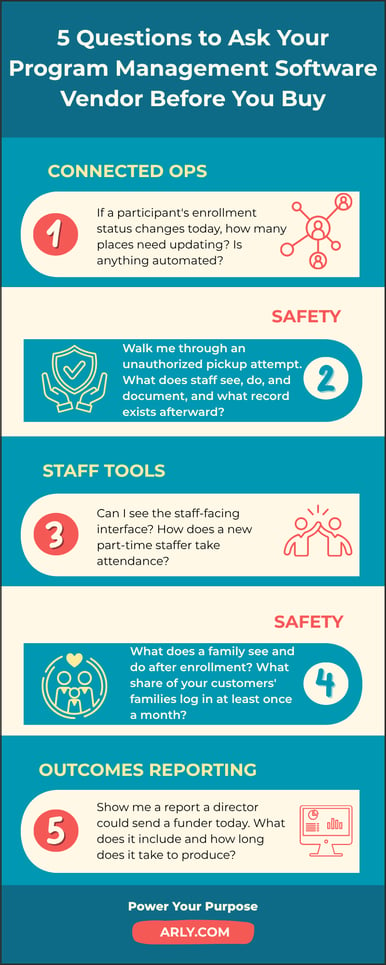
If a participant's enrollment status changes today, how many places does someone have to update — and how many of those updates are automatic?
 2. It takes participant safety seriously, with structure, not just fields
Every platform has a place to enter emergency contact information. That's not safety infrastructure. That's a database.
Real participant safety requires structure. It means knowing exactly who is in your building at any given moment — and being able to verify it. It means check-in and check-out processes with authentication that protects children, not just clipboard signatures. It means incident reporting that captures what happened, creates a documented record, and notifies the right people — including families — with the appropriate level of detail.
For programs serving children, youth, and families, safety compliance isn't a feature. It's the table stakes. Your software should treat it that way: configurable attributes that match your program's specific requirements, secure audit trails, and check-out workflows that ensure children leave with who they're authorized to leave with.
ASK YOUR VENDOR:
Walk me through what happens when a participant is attempted to be picked up by someone who isn't on the authorized list. What does the staff member see, what do they do, and what record exists afterward?
3. It equips your staff, not just your administrators
Program management software is often built from the top down: for the director, the registrar, the billing coordinator. The staff member running the after-school session, managing fourteen kids in a classroom, and trying to log attendance on a tablet between activities is an afterthought.
That's a problem. Because your staff are the program. If the software makes their job harder — more steps, more screens, more confusion — it doesn't matter how good the reporting dashboard looks to the director.
Staff tools should be simple enough to use in motion. Attendance should take seconds, not minutes. Activity scheduling should be clear. Incident documentation should be accessible when something happens, not after a staff member finds time to log in on a desktop. And onboarding new staff — a constant reality in youth programming — should require hours, not weeks.
ASK YOUR VENDOR:
Can I see the staff-facing interface? How does a new part-time staff member take attendance or access relevant program information on their first week?
4. It creates a family experience families actually use
Family engagement is one of the strongest predictors of program outcomes. Programs know this. Yet most software treats the family-facing experience as a registration portal — a place to sign up and pay, not a place to stay connected.
The best platforms extend your program's relationship with families beyond enrollment. That means communication tools that reach families where they are. Transparency into what's happening with their child's experience; frictionless payments that don't create barriers to participation; and check-in and check-out processes that give families confidence, not friction.
The measure isn't whether you have a family portal. It's whether families choose to use it — and whether it strengthens their connection to your program or just adds another login to their lives.
ASK YOUR VENDOR:
What does a family see and do in your platform after enrollment? What percentage of y our customers' families log in at least once a month.
5. It produces outcomes reporting, not just activity data
Every platform generates reports. Attendance numbers, enrollment counts, billing summaries. That's data about your operations. It is not the same as evidence of your program's impact.
Funders — government agencies, foundations, school district partners — increasingly require programs to demonstrate outcomes, not just activity. The right platform makes that possible without requiring a data analyst and a week of preparation before every grant report.
Outcomes reporting means tracking what matters to your stakeholders: academic progress, participant growth, attendance trends that correlate with outcomes, program quality indicators. It means being able to generate a funder-ready report and a programmatic improvement report from the same data, without rebuilding a spreadsheet every time.
If your software can't answer "Is your program working?" — not just "Did your program run?" — it isn't built for where the field is heading.
ASK YOUR VENDOR:
Show me a report a program director could send to a government funder today. What does it include, and how long does it take to produce?
One platform that meets all 5 criterion — built by people who've run programs
Arly is the first AI-powered program management platform built on 35 years of evidence, research, and experience. Every capability was designed around how youth-serving programs actually operate — not adapted from a generic workflow tool.
Connected operations, verified check-in and check-out, staff tools that work in the field, family engagement that extends beyond enrollment, and reporting built for funders and program quality alike. It's one system, not a collection of modules held together by hope.
And with Arly Compass — the AI guide built into the platform — setup, support, and program management get smarter over time.

%20(77).png)